They’re All Blonde: An Interview with Romy Owens by Sarah Atlee
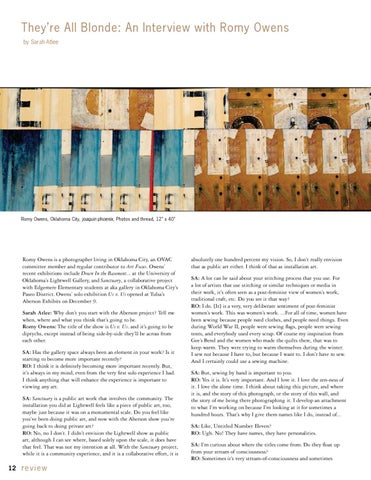
Romy Owens, Oklahoma City, joaquin phoenix, Photos and thread, 12” x 40”
Romy Owens is a photographer living in Oklahoma City, an OVAC committee member and regular contributor to Art Focus. Owens’ recent exhibitions include Down In the Basement... at the University of Oklahoma’s Lightwell Gallery, and Sanctuary, a collaborative project with Edgemere Elementary students at aka gallery in Oklahoma City’s Paseo District. Owens’ solo exhibition Us v. Us opened at Tulsa’s Aberson Exhibits on December 9. Sarah Atlee: Why don’t you start with the Aberson project? Tell me when, where and what you think that’s going to be. Romy Owens: The title of the show is Us v. Us. and it’s going to be diptychs, except instead of being side-by-side they’ll be across from each other. SA: Has the gallery space always been an element in your work? Is it starting to become more important recently? RO: I think it is definitely becoming more important recently. But, it’s always in my mind, even from the very first solo experience I had. I think anything that will enhance the experience is important to viewing any art. SA: Sanctuary is a public art work that involves the community. The installation you did at Lightwell feels like a piece of public art, too, maybe just because it was on a monumental scale. Do you feel like you’ve been doing public art, and now with the Aberson show you’re going back to doing private art? RO: No, no I don’t. I didn’t envision the Lightwell show as public art, although I can see where, based solely upon the scale, it does have that feel. That was not my intention at all. With the Sanctuary project, while it is a community experience, and it is a collaborative effort, it is
12
re v i e w
absolutely one hundred percent my vision. So, I don’t really envision that as public art either. I think of that as installation art. SA: A lot can be said about your stitching process that you use. For a lot of artists that use stitching or similar techniques or media in their work, it’s often seen as a post-feminist view of women’s work, traditional craft, etc. Do you see it that way? RO: I do. [It] is a very, very deliberate sentiment of post-feminist women’s work. This was women’s work. ...For all of time, women have been sewing because people need clothes, and people need things. Even during World War II, people were sewing flags, people were sewing tents, and everybody used every scrap. Of course my inspiration from Gee’s Bend and the women who made the quilts there, that was to keep warm. They were trying to warm themselves during the winter. I sew not because I have to, but because I want to. I don’t have to sew. And I certainly could use a sewing machine. SA: But, sewing by hand is important to you. RO: Yes it is. It’s very important. And I love it. I love the zen-ness of it. I love the alone time. I think about taking this picture, and where it is, and the story of this photograph, or the story of this wall, and the story of me being there photographing it. I develop an attachment to what I’m working on because I’m looking at it for sometimes a hundred hours. That’s why I give them names like I do, instead of... SA: Like, Untitled Number Eleven? RO: Ugh. No! They have names, they have personalities. SA: I’m curious about where the titles come from. Do they float up from your stream of consciousness? RO: Sometimes it’s very stream-of-consciousness and sometimes